
Scafell Pike and Striding Edge make a natural pair for one Lake District trip. They are different kinds of day. One is a long walk to the highest ground in England. The other is a sharp ridge on a lower mountain. This guide sets out how each one behaves and how to plan around them.
- Scafell Pike offers several approaches, and the one you choose sets the day’s length and difficulty.
- Striding Edge is a narrow ridge on Helvellyn, a mountain with a long record of accidents.
- Winter changes the commitment on both, so plan the pair around weather windows rather than fixed dates.
What makes these two walks so different?
The two objectives test different skills. Scafell Pike is mostly about distance, height gained and finding your way. Striding Edge is about footing and nerve on a narrow crest.
Scafell Pike is the highest mountain in England, at 978 metres (3,209 ft). Walkers cover a lot of ground to reach it, and the upper section is rocky. Several approach paths lead there, each with its own character.
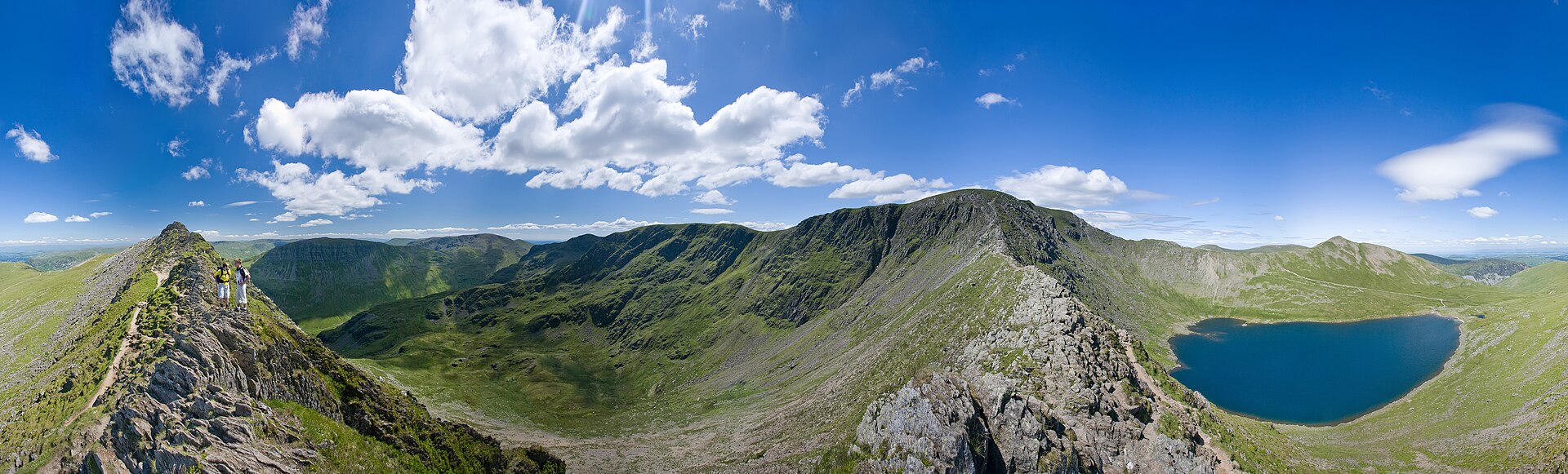
Helvellyn is a different animal. It is the third-highest point in England and in the Lake District. Its eastern face has deep glacial coves separated by sharp-topped ridges, and Striding Edge is one of them. The ridge leads onto the summit plateau, a broad area that stays above 900 metres for about a kilometre.
Here is how to think about each one:
- Scafell Pike: a long mountain day where route choice and navigation matter most.
- Striding Edge: a shorter, more exposed outing where the ridge itself is the challenge.
- Together: two very different tests that suit separate days rather than a single push.
Which route up Scafell Pike should you choose?
Four main routes climb Scafell Pike. They differ in length, remoteness and how easy they are to follow. Choosing well is half the planning.
The Wasdale Head route
This is the most popular line, and some people call it the Tourist Route. It is the easiest of the four, but it still asks for decent fitness and mountain awareness. It starts at the National Trust car park at Wasdale and climbs through the valley before steepening. Higher up, the ground turns rocky with loose scree.
It is the best option if you are inexperienced or unsure of yourself. It is relatively well marked, but it can be harder to follow in poor conditions.
The Corridor Route
This one starts at Seathwaite in Borrowdale and is longer and more demanding. Many walkers who have done both find it the more scenic. It crosses Stockley Bridge, climbs Styhead Pass, then traverses the western slopes of the mountain past Great End and Broad Crag. It joins the Wasdale route for the final section.
It makes a good step up from the Tourist Route. It also suits walkers who prefer quieter paths.
The Eskdale and Langdale routes
These are the two big approaches. The Eskdale route starts at Brotherilkeld Farm and follows the River Esk. It is harder to navigate and more strenuous, and the last stretch is steep with some scrambling. The Langdale route is the longest of the four. It starts at Old Dungeon Ghyll Hotel and is not one to start late or with light running short.
Treat both as serious, committing days.
How serious is Striding Edge?
Striding Edge is a sharp-topped ridge on the eastern side of Helvellyn. It is one of two such ridges there, the other being Swirral Edge. Between them sits Red Tarn, which fills the middle of the three deep glacial coves.
Do not treat the ridge as a casual stroll. The mountain has a history of fatalities over the past two hundred years. The artist Charles Gough is better known for dying on Striding Edge in 1805 than for his work in life.
Plan with that in mind:
- Pick a day with settled weather and good visibility.
- Keep your hands free and your pack light.
- Move at a steady pace and do not rush the crest.
- Turn back if wind or cloud builds before you commit to the ridge.
The summit, both edges and the wider Glenridding Common have been managed since 2020 by the John Muir Trust, a conservation charity, in partnership with the Lake District Park Authority. That makes it a place worth treating with care as well as respect.
Once the ridge ends, you reach the summit plateau. Navigate carefully there in poor visibility, because the plateau is broad and the cliffs lie to the east.
How does winter change the picture?
Winter turns both walks into different propositions. The same route can feel routine in July and serious in January.
Four things change:
- Short daylight shrinks the time you have, which hurts most on long approaches.
- Navigation gets harder when paths and cairns are buried and cloud sits low.
- Cold drops quickly with height, so layers and food matter more.
For Scafell Pike, the longer routes become much harder in these conditions. The Langdale route is already long, and short days make a late start a poor idea.
For Striding Edge, ice on a narrow crest is a very different problem from a dry summer ridge. If you do not have that experience, wait for better conditions or go with a qualified guide.
Always check a mountain forecast before you go. Reputable sources for this include the Mountain Weather Information Service, Windy and the Met Office mountain forecast.
How should you plan kit, crowds and the order of the two days?
Good planning here is mostly about flexibility. Weather in the Lake District changes fast, so a fixed schedule is a weak plan.
Kit
Carry the basics on both days:
- Sturdy walking boots.
- Waterproof jacket and trousers.
- Several layers, since temperatures can fall quickly.
- A map and compass, and the skill to use them.
- Enough food and water for the whole day.
- A headtorch in the colder months.
Take out everything you carry in.
Parking and crowds
Popular starts fill up. Arrive early, especially in summer and at weekends. Busy days can bring long lines of walkers on the most popular route, so an early start also gives you quieter paths and more daylight in hand.
Sequencing the days
Do not lock in an order before you see the forecast. Here is a simple approach:
- Give yourself at least two or three days in the area.
- Look at the mountain forecast the evening before each day.
- Use the clearest, calmest day for the ridge, because visibility and wind matter most on Striding Edge.
- Use the other day for Scafell Pike, choosing a route that fits the conditions and your fitness.
If one day looks poor, swap them or wait. Mountains do not mind how long you take.
Frequently asked questions
Can you walk Scafell Pike and Striding Edge on the same trip?
Yes, and it works well as a pair. They are in different parts of the Lake District, so plan them as separate days. Keep your schedule flexible so you can match each walk to the best weather.
Which Scafell Pike route is best for a first attempt?
The Wasdale Head route is the most popular and the easiest of the four main routes. It still needs good fitness and mountain awareness. Walkers who want a bit more challenge and a quieter path often move on to the Corridor Route.
Is Striding Edge dangerous?
It is a narrow, sharp-topped ridge, and there have been fatalities on Helvellyn over the past two hundred years. In dry, clear conditions many walkers cross it with care. In wind, ice or low cloud it becomes much more serious, so be ready to turn back.
Do you need winter kit for these walks?
In winter conditions you may well need crampons and an ice axe, along with the skills to use them. Short daylight and harder navigation add to the commitment. If you lack that experience, wait for better conditions or go with a qualified guide.
Related reading
- Dartmoor and Exmoor: A Planning Guide to Moorland Walking in the South West
- The Yorkshire Three Peaks and Beyond: Planning a Walk in the Dales
Sources
- Quick Guide to Scafell Pike Routes (climb-scafell-pike.co.uk, accessed 2026-11-04)
- Helvellyn — Wikipédia (en.wikipedia.org, accessed 2026-11-04)
Photo: Helvellyn Striding Edge 360 Panorama, Lake District – June 09, by Diliff, CC BY-SA 3.0 (Wikimedia Commons)