
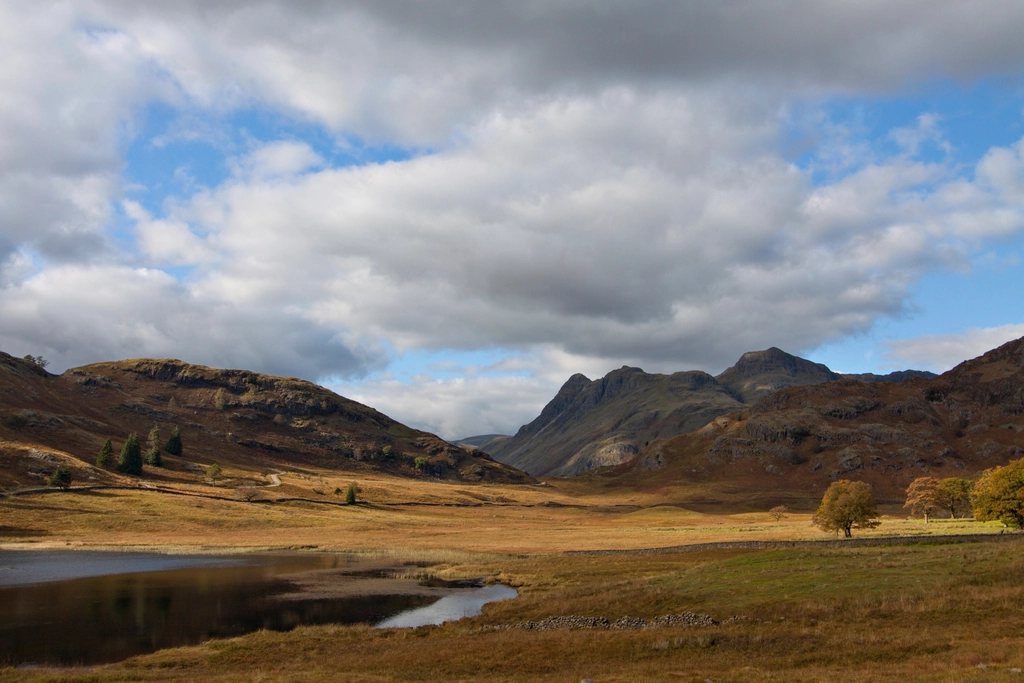
Somewhere in the Lake District, on any given weekend, someone is standing on a summit that they would never have chosen for its own sake, ticking a box. The summit might be Mungrisdale Common, a swelling of grass with no discernible top, or Armboth Fell, a heathery bog above Thirlmere. They are there because both are Wainwrights, and the Wainwrights are a list, and lists have a way of taking over. This is an account of what the list is, why it has the shape it has, and how people go about completing it, from a relaxed twenty-year wander to a single running lap of under six days.
Seven books, 214 summits
Between 1955 and 1966 Alfred Wainwright, a borough treasurer in Kendal, produced seven hand-drawn guidebooks to the fells of Lakeland. Every page was written and illustrated by pen, with no typesetting, and each fell was given its own chapter with ascent diagrams, ridge routes and a summit view. The seven volumes divide the district by geography: the Eastern Fells with 35 summits, the Far Eastern Fells with 36, the Central Fells with 27, the Southern Fells with 30, the Northern Fells with 24, the North Western Fells with 29, and the Western Fells with 33. Add them up and the total is 214. Wainwright never intended the books as a list to be completed, and said so, but the numbering of the chapters did the work for him.
The selection is personal rather than mathematical. There is no minimum height and no minimum drop between one summit and the next. Castle Crag in Borrowdale, at 290 metres, is the only Wainwright below 1,000 feet and made the cut because Wainwright thought the crag deserved it. Scafell Pike, at 978 metres, is the highest. Several tops that would qualify by any topographical measure were left out, and several that would not, such as the Common mentioned above, were left in. A separate eighth book, published in 1974, covers 116 Outlying Fells on the fringes of the district; those are a different list, and most people treat them as a separate project.
Why people bother
The honest answer is that the list is a reason to go where you would not otherwise go. A walker who only ever climbs the famous fells sees perhaps thirty summits and spends a lot of time on eroded paths behind other people. The list drags you into the Northern Fells behind Skiddaw, where the paths are faint and the valleys empty, and to the low outliers around Loweswater that turn out to have the finest views of the high ones. It also gives shape to a lifetime of walking. Many finishers describe the round less as an achievement than as a way of making sure they went everywhere once.
A society dedicated to the author keeps a voluntary register of completions, and the numbers there suggest a few hundred finishers each year, though the real figure is certainly higher since most people never register. Completion is usually celebrated on a chosen final fell; Haystacks is the traditional choice, because Wainwright asked that his ashes be scattered beside Innominate Tarn on its summit plateau, and they were, after his death in 1991.
The arithmetic of a round
Linking all 214 summits in a single continuous journey on foot works out at roughly 525 miles, or about 850 kilometres, with something over 36,000 metres of ascent, the equivalent of four Everests from sea level. Nobody sensible does it that way. Broken into day walks, the fells group naturally into horseshoes and ridges, and the standard approach is to take them a valley at a time. The Fairfield Horseshoe from Ambleside collects eight summits in a single day of around 16 kilometres. The Coledale Round above Braithwaite and the Newlands Horseshoe each yield eight to ten. The Kentmere Horseshoe in the Far Eastern Fells gives nine or ten depending on the diversions. A fit walker who plans well can finish in around seventy to eighty days of walking; most people who set out to do it take somewhere between five and fifteen years, with the last twenty fells being the awkward ones scattered on their own that no horseshoe collects.
Ways of going about it
There is no correct order, but there are recognisable schools of thought:
- Book by book: finish all the fells in one volume before starting the next. Neat, but it means a great deal of driving to the same valleys.
- By horseshoe: pick the classic rounds first and mop up the leftovers at the end. This is how most people actually do it, whether they planned to or not.
- Highest first or lowest first: the former front-loads the big days while the knees are willing; the latter saves the summits with the best views for the finish.
- Continuous: a single backpacking or running journey linking every summit. The continuous running record has been brought under six days, and a self-supported walking round typically takes three to five weeks.
- Seasonal rules: some walkers insist on every fell in winter, or every fell under a full moon, or every fell from a different starting valley. These are ways of making a finished list start again.
The fells nobody looks forward to
Every finisher has a private list of the summits they did purely because they had to, and the same names recur. Mungrisdale Common is universally cited: a broad grassy shoulder off Blencathra whose highest point is disputed, and which Wainwright himself described in unflattering terms. Armboth Fell and High Tove above Thirlmere are wet enough that a dry crossing is worth remembering. Yoke and Sallows near Kentmere are pleasant enough but low and rounded, and easily forgotten between the bigger fells either side. On the other hand, the low western outliers such as Mellbreak, Rannerdale Knotts and Low Fell are among the best short walks in the district, and are only overlooked because they are small. The list is at its most useful precisely here: it makes you go, and you find that the fell knew better than you did.
A note on the ground
Completing the Wainwrights involves a good deal of pathless walking and some minor scrambling. Sharp Edge on Blencathra and Striding Edge on Helvellyn are the two famous ridges; neither is compulsory, since both fells have easy alternatives, but both are on most people’s rounds. Jack’s Rake on Pavey Ark is harder than either and is not needed for the summit at all. In winter the eastern and central fells hold snow for weeks at a time and the rules change entirely. The single best piece of advice we can give anyone starting the list is to buy the paper maps, learn to read them, and treat the guidebooks as what they were meant to be: a companion for the day, and not a set of instructions.