
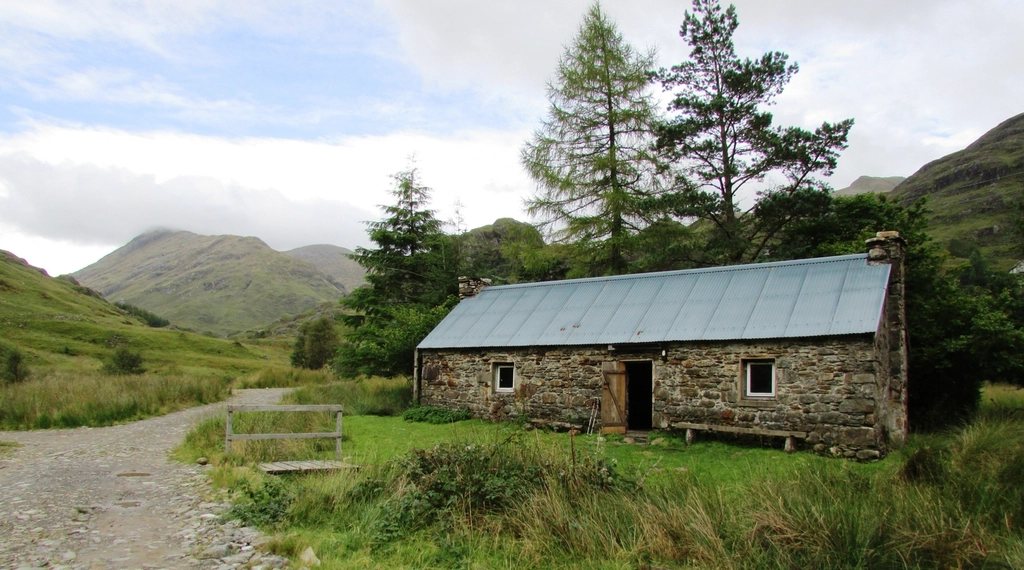
A bothy is a simple, unlocked shelter left open for anyone to use, free, without booking, and usually far from a road. Most began as shepherds’ cottages, keepers’ houses or estate buildings abandoned when the people who lived in them left the hills. Today around a hundred of them are maintained across Scotland, northern England and Wales by a volunteer charity, with the consent of the landowners, and they are one of the quiet glories of British walking. They are also fragile, in the sense that they exist entirely on goodwill. A single bad night, a fire left burning or a shed full of rubbish, and an estate can withdraw its permission. So the etiquette is not decoration. It is the reason the door is still open.
What a bothy is, and what it is not
Expect four stone walls, a roof that keeps out most of the rain, a sleeping platform or a bare wooden floor, and perhaps a fireplace or a stove. Expect nothing else. There is no water supply beyond the burn outside, no electricity, no bedding, and very rarely a toilet. There is no warden and no way to reserve a place, which means there is no guarantee of a bed either. A walker who arrives at a popular shelter on a Saturday in May with no tent has made a planning error, not had bad luck. We always carry a tent or a bivvy bag and treat the bothy as a bonus.
Some sit in celebrated positions. Corrour, in the Lairig Ghru at about 570 metres, has been a refuge for walkers crossing the Cairngorms for over a century. Shenavall, in the Fisherfield hills, is the base for one of the longest rounds of Munros in the country. Greg’s Hut, just below the summit of Cross Fell on the Pennine Way, is the highest in England at around 700 metres. Others are modest sheds in nameless glens, and those are often the better nights.
The Bothy Code
The charity that looks after the network publishes a short code, and every point in it exists because someone once did the opposite. We paraphrase it here, because it is the whole of bothy etiquette in a few lines.
- Respect other users. Leave the bothy clean and tidy, with dry kindling for the next person, and make room for later arrivals even if that means moving your kit.
- Respect the bothy. Report any damage. Do not burn the furniture, the doors or the roof timbers, and do not leave perishable food that attracts mice.
- Respect the surroundings. Take out all rubbish that you did not find there. Bury human waste well away from the building and from any water, and carry a small trowel to do it properly.
- Respect the agreement with the estate. Observe any notices about stalking or lambing, and do not camp on the ground immediately around the building if asked not to.
- Respect the restriction on numbers. Groups of six or more, and anyone planning to stay more than a couple of nights, should not use a bothy. It is a shelter, not a base camp.
Fires, fuel and the things people get wrong
Fire is where the culture and the code meet. A bothy fire on a wet November evening is one of the great pleasures of the British hills, and a bothy fire fed with the shelf the last person prised off the wall is the reason bothies get locked. The rule is simple: carry your fuel in. A bag of coal or a couple of logs strapped to a rucksack is a small price for a warm evening, and any driftwood or fallen timber near the building has usually been gathered years ago. Never cut living wood. Leave the fire out and cold before you go, and leave the kindling you did not use.
Candles are the other lesson. They burn down, they get knocked over, and they are the reason some bothies carry black scorches on the sleeping platform. A headtorch is safer. If you do use candles, use them on a saucer on a stone surface and blow them out before you sleep.
Sharing the space
The culture of the bothy is one of understatement. You arrive, you say hello, you ask which end is free, and you take up as little of it as you can. Latecomers are welcomed rather than resented, because everyone has been the one arriving at ten o’clock in the rain. Boots come off at the door or at least stay off the platform. Music, if anyone brought it, stays quiet and stops when the first person lies down. The bothy book, where there is one, is for a short note of your route and the conditions, and reading old entries by torchlight is a large part of the charm.
Dogs are a matter of judgement. Most walkers are relaxed about a well-behaved dog on a wet night, provided it stays off the sleeping platform and away from other people’s food. A soaked, muddy dog shaking itself over someone’s sleeping bag is a different matter. Ask before assuming.
Seasons, stalking and closures
Many bothies stand on sporting estates, and the agreement that keeps them open depends on walkers respecting the deer season. Stag stalking in Scotland runs from the start of July to 20 October, with the busiest period in September and October, and some estates ask that particular bothies are avoided on stalking days or for the whole season. Notices are posted at the building and on the charity’s website, and we check before setting out. Lambing, in April and May, is the equivalent in the lower glens: keep dogs on a lead and stay away from the in-bye fields.
Some shelters close for months at a time for renovation, because the work is done by volunteers carrying materials in on foot or by helicopter when funds allow. A bothy that was open last year may be a shell of scaffolding this year. Again, check, and again, carry a tent.
Why it matters
The network survives because it is largely invisible to anyone who does not walk. Estates permit it because it costs them nothing and causes no trouble. The moment it causes trouble, it costs them their patience, and there is no formal right of anyone to sleep in someone else’s building. Every bothy night, then, is a small act of trust. Treat it like that: leave the place cleaner than you found it, put a few pounds in the charity’s tin if you use the shelters regularly, and say nothing on social media about where the good ones are. The people who need to know already do.