
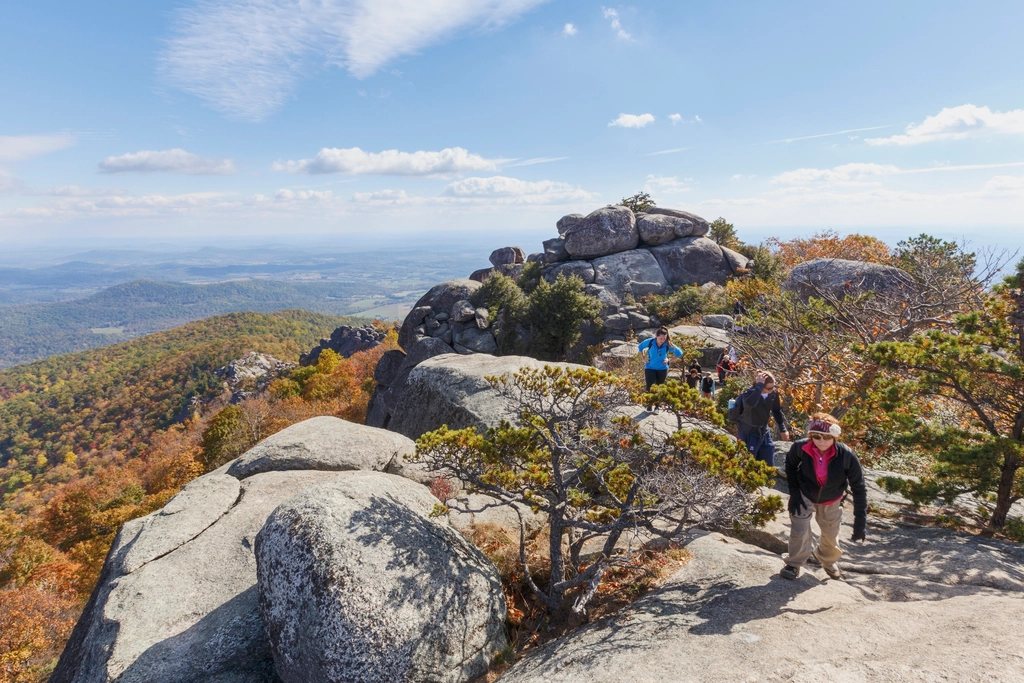
Scrambling is the ground between walking and climbing: the point at which a hill route needs hands as well as feet, and at which a slip stops being a bruise and starts being a fall. British guidebooks grade it on a scale of 1 to 3, sometimes with an S for “serious” added at the top. The scale looks tidy. In practice it is a rough guide written by different authors in different decades, and the difference between a dry Grade 1 in June and the same rock in a wet October gale is larger than the difference between the grades themselves. Here is what the numbers mean, what they leave out, and which classic routes sit where.
Where the scale comes from
The grades were popularised by the guidebook writers of the 1960s and 1970s who catalogued the ridges and gully lines of the Lake District, Snowdonia and the Highlands. They were never formalised by a governing body, which is why one author’s Grade 2 is another’s Grade 3. The scale runs beneath the rock-climbing grades, so that the hardest scrambles overlap with the easiest climbs: a Grade 3 scramble and a rock climb graded Moderate or Difficult are often the same piece of rock described from different directions. The winter grades, given in Roman numerals, are a separate system altogether, and the same ridge under snow is a different undertaking.
Grade 1: exposed walking with hands
A Grade 1 scramble is a walk where the hands are used for balance and occasional pulling, on ground that is exposed enough to concentrate the mind. The route is usually obvious, the holds are large, and a competent walker with a head for heights needs no rope. What Grade 1 does not mean is safe. Several of the most notorious accident sites in Britain are Grade 1 ridges, because they attract people who have never scrambled before and who arrive in the wrong conditions.
The classics are famous for a reason. Striding Edge, the eastern arete of Helvellyn, is a narrow crest with an awkward downclimb at the end before the final pull to the summit. Crib Goch, on the horseshoe of Snowdon, is a knife-edge at over 900 metres with a traverse of pinnacles beyond it. Sharp Edge on Blencathra is short but its slabby rock is polished and treacherous when wet. Jack’s Rake, a diagonal shelf across the face of Pavey Ark in Langdale, is often described as the hardest of the Lakeland Grade 1s because of a couple of steep steps with big drops beneath. The north ridge of Tryfan and Bristly Ridge on Glyder Fach form a Grade 1 link that gives a full day of hands-on ground in the Glyderau.
Grade 2: harder moves, real exposure
At Grade 2 the moves become genuinely climbing moves, if only for a few metres at a time, and the exposure is such that a fall would probably be fatal. Route-finding matters: the easiest line is not always obvious, and the wrong line can lead quickly onto rock-climbing terrain. Many parties carry a short rope and a few slings for confidence on the hardest steps or for a nervous companion. Grade 2 is where we advise people to have some rope skills before they set out, not because the rope is always used but because the day may require it.
The Aonach Eagach in Glen Coe is the standard Grade 2. It is a ridge of roughly two kilometres between Meall Dearg and Sgorr nam Fiannaidh with no safe escape from the crest, so a party that starts must finish. The Forcan Ridge on The Saddle in Kintail is a shorter, more amenable Grade 2 with an optional harder direct line. Ledge Route on the north face of Ben Nevis, despite the setting, is a fairly straightforward Grade 2 in dry conditions. In Snowdonia, the east ridge of Y Garn and the harder parts of the Glyderau give Grade 2 ground close to the road.
Grade 3: climbing in all but name
Grade 3 scrambles are easy rock climbs by another name. Expect steep rock, small holds, sustained exposure and sections where a fall is not survivable. A rope is normal, the leader should be able to place protection and build a belay, and the party should be prepared for the route to feel harder than the guidebook suggested. Retreat from a Grade 3 is frequently more difficult than continuing, which is why the S suffix exists in some guides: it flags routes where the consequences of a mistake are especially severe or where escape is impractical.
Tower Ridge on Ben Nevis is the great British Grade 3: around 600 metres of climbing on the north face with the Eastern Traverse and the Tower Gap near the top, where many parties are caught out by nightfall. Pinnacle Ridge on St Sunday Crag in the Lake District is a short, sharp Grade 3 with a notoriously awkward chimney. The Cneifion Arete in Cwm Idwal is a Grade 3 that is often climbed as a Difficult rock route. And the main ridge of the Cuillin on Skye, taken end to end, is Grade 3 scrambling for much of its length with several pitches of proper rock climbing, of which the Inaccessible Pinnacle is only the best known.
What the grade does not tell you
Conditions move everything by a grade or more. Wet rock, particularly on the polished Lakeland classics, turns a Grade 1 into something requiring real care. Wind on a knife-edge is a hazard of its own that the grade ignores. A single patch of verglas in November can make a Grade 1 impassable without an axe and crampons, at which point it is a winter climb and the scrambling grade is irrelevant. Length and commitment are not graded either, and a two-hour Grade 2 near the road is not comparable to eight hours on a remote ridge with the same technical difficulty.
The other missing variable is the scrambler. Confidence on exposed ground is not the same as technical ability, and both can be trained. Many walkers move happily on Grade 1 and are frightened by Grade 2, and the fear is not irrational; it is a correct reading of the consequences.
Moving up through the grades
The sensible progression is slow. Do several Grade 1 routes in good conditions, then repeat one or two in poorer weather to learn what wet rock feels like. Learn to move on three points of contact, to test holds before committing weight, to face into the rock on descent and to keep the rope, if you carry one, from becoming a hazard of its own. Take a course, or go out with people who already climb, before moving to Grade 2. Above that, the honest answer is that you have started rock climbing, and the skills of belaying and placing gear are not optional extras. There is no shame in that. It is what the grades were designed to tell you.